

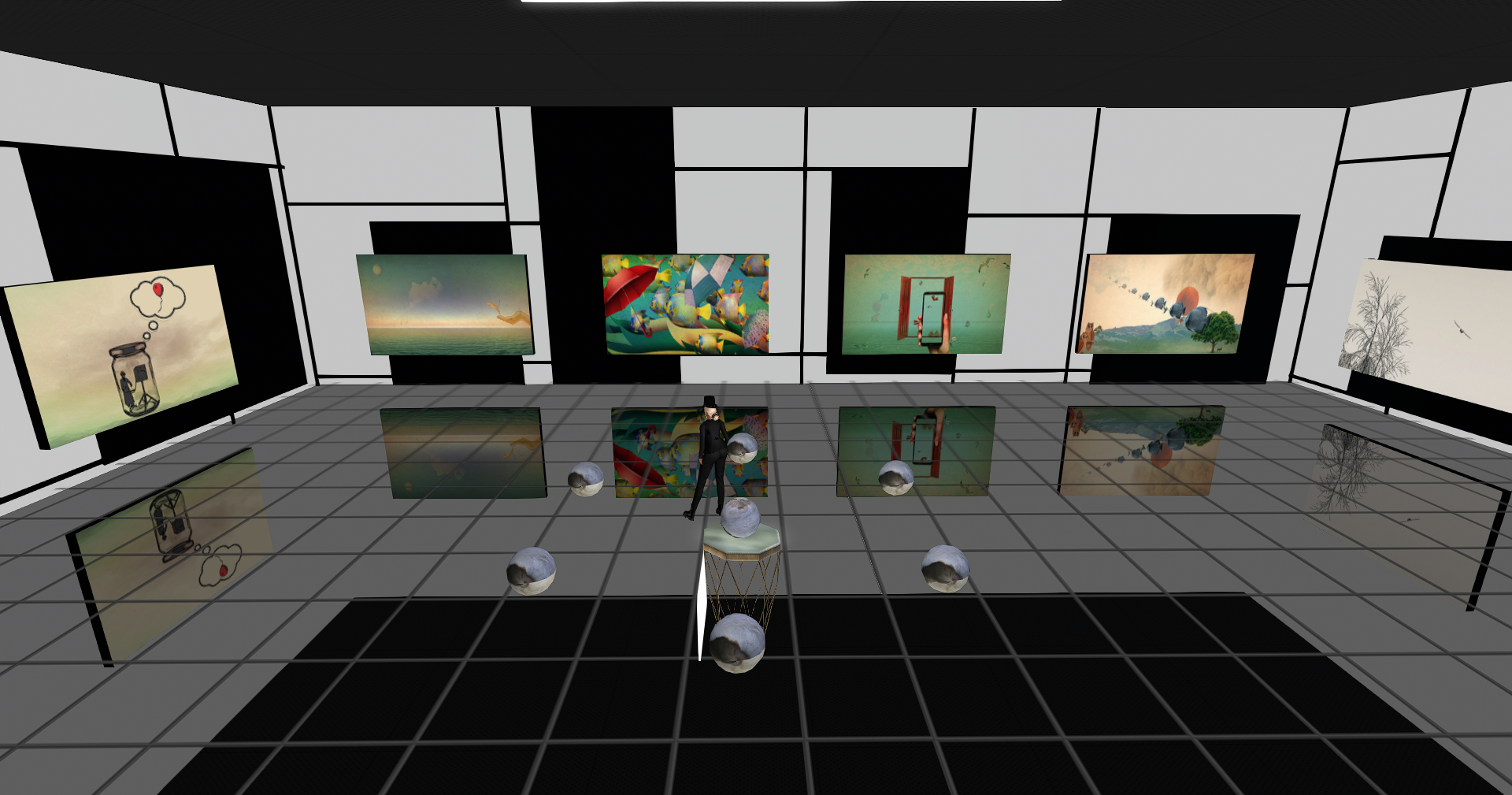
The Metaverse Museum presents The Molecules of Art, a new curatorial project conceived by Professor Roberto Presicci that introduces an innovative approach to showcasing virtual native art in immersive worlds.
The project will be presented in World in the MdM sim on Friday 29 May at 22:00 CET – 13:00 PTD
For the first time, the traditional critical text is transformed into an interactive structure composed of navigable spheres capable of linking works, cultural references, artistic poetics and connections with the contemporary art system.
Each Molecule of Art stems from in-depth curatorial research into the works and exhibition spaces of the artists involved in the project.
The molecular structure is not applied from the outside, but integrates directly into the aesthetic universes created by the artists, adapting to their different artistic approaches and immersive modes.
The visitor initially encounters a single visible sphere.
Through interaction, the molecule is progressively activated, opening up new explorable nodes. Each sphere is clickable and leads to web content hosted on the Metaverse Museum’s server, where visitors can explore cultural references, artistic genealogies and aesthetic connections linked to the artist.
The journey traverses different forms of virtual native art:
- the conceptual cartography of the virtual in Marco Manray Cadioli’s Manrayite;
- the visionary thresholds of Kimeu Korg’s Kimeukorgite;
- the editorial and symbolic aesthetics of Bruno Cerboni’s Brunocerbonite;
- the synthetic and post-avatar identities of Chris Tower’s Christowerite;
- the metaphysical atmospheres of Daco Monday’s DacoMondayte;
- the playful, immersive pop art of Tina Bey’s TinaBeyte;
- the landscape contemplation of Fiona Saiman’s Saimanite.
With this project, the Metaverse Museum proposes a new form of immersive curation, where critical thinking becomes an integral part of the virtual experience and guides the visitor through interactive and relational artistic environments.
The Molecules of Art thus open up new perspectives for museology in virtual worlds and for the development of critical tools native to the immersive experi
