

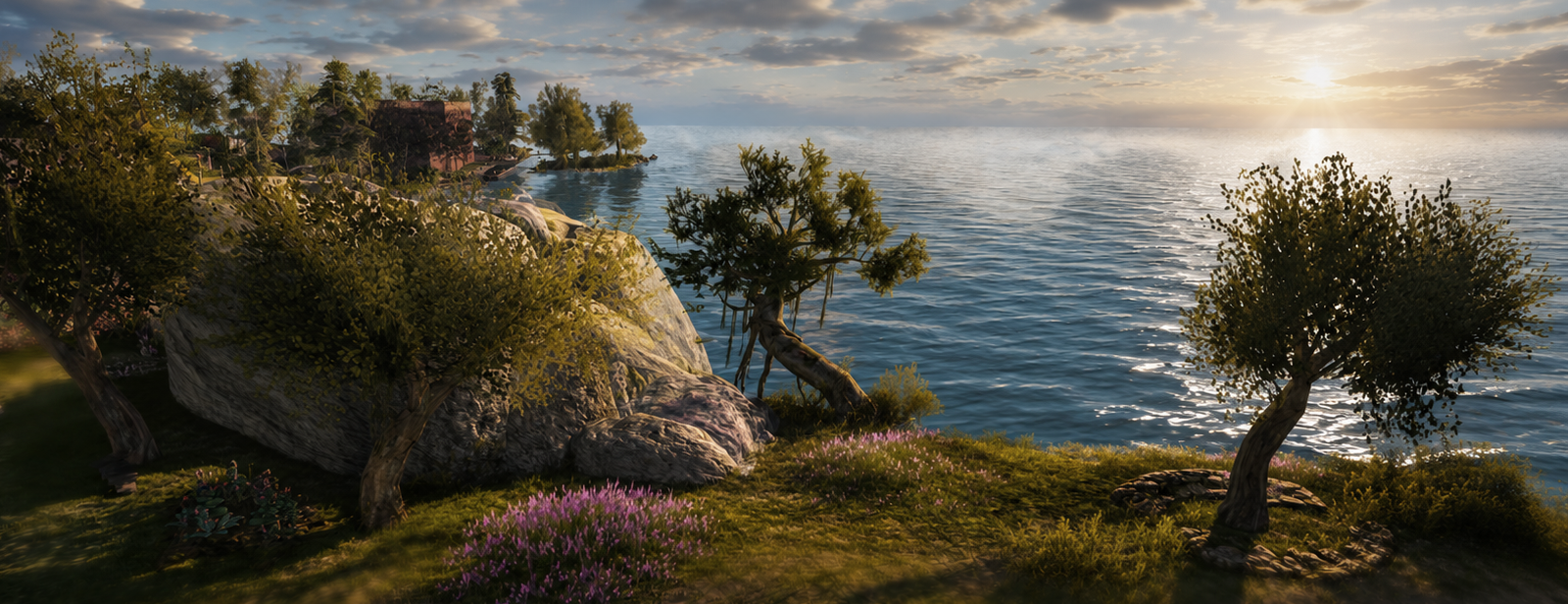
Creating a landscape in a virtual world is not simply a technical process: it is an act of sensitive construction, almost a form of silent storytelling. In many environments within Craft World, what appears to be merely a “background” is actually the first language through which a space tells its story.
A virtual landscape always begins with a simple initial idea: what atmosphere should this place evoke? Before objects, before structures, there is a feeling to translate into space. It may be serenity, desolation, lush nature, memory, or something surreal and suspended between reality and imagination. This first choice guides everything that follows.
The first layer is the terrain itself. In virtual worlds, creators often use sculpting tools to raise, lower, and shape the land. This is where the emotional geography of a place begins to emerge: soft hills may evoke calmness, irregular surfaces can suggest tension or drama, and open plains create a sense of freedom and breath. It is not only about form, it is also about visual rhythm.
Then come vegetation and natural elements. Trees, grass, rocks, and water all contribute to shaping the identity of a space. Here too, choices are never random. A few carefully placed elements can create more atmosphere than an overcrowded scene. The use of empty space is just as important as what fills it.
Light is one of the most powerful tools available. In virtual environments, creators can control the time of day, intensity, and the color of ambient light. Warm, low light can transform a simple landscape into something nostalgic. Cooler, softer lighting may create a dreamlike or suspended feeling. Light does not merely illuminate; it creates meaning.
Another essential element is the camera, or point of view from which the landscape is experienced. Raising the camera can provide a broad, contemplative perspective, while lowering it closer to ground level makes the environment feel more immersive and intimate. Even framing choices can completely transform how a place is perceived.
In more advanced creation platforms, it is often possible to adjust the level of detail and rendering distance of objects. This allows creators to decide whether a landscape should appear crisp or soft, realistic or stylized. In many ways, it becomes a form of control over the emotional distance of an image.
At this stage comes the most personal phase: narrative composition. A virtual landscape is never only about aesthetics. It becomes a story without characters, in which every element hints at presence or absence. A pathway may suggest recent footsteps. An isolated house may evoke an interrupted story. A solitary tree in an open space can become symbolic.
Finally comes refinement: light fog, floating particles, subtle color adjustments, atmospheric effects. These may seem like minor details, yet they are often what make a landscape feel alive and emotionally resonant.
Creating a landscape in a virtual world, therefore, means building a space that is not meant only to be seen but also to be felt. A place that may not physically exist, yet is still capable of holding emotions, memories, and meaning.
Perhaps the most fascinating part comes when everything finally seems complete. Because even in the most carefully designed landscape, what truly brings it to life are the people who inhabit it and the emotions they choose to leave behind. Without that presence, even the most beautiful place risks becoming little more than a backdrop: evocative to the eye, but silent. After all, a landscape without stories is a bit like a painting hanging on a wall: beautiful to look at, but unable to truly hold an emotion.
“Nature does nothing in vain” (Aristotle)
(not even in the virtual world)
